WHY FITTING CARE MATTERS
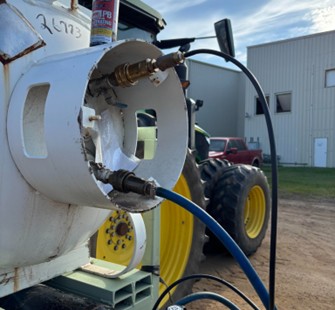
Have you ever opened the cover on a pig (cylinder) and looked closely at the quick-connect fittings? They may still connect, but that does not always mean they are clean, sealing properly, or ready to use.
These fittings are an integral part of the safe and efficient closed-handling system used for TELONE™ by Teleos soil fumigation applications. Dirt, moisture, rust, residue, worn caps, or hose strain can turn a simple hookup into a leak, poor seal, or equipment problem. Before transfer or application, take a few seconds to look inside the fitting and make sure it is ready to use safely.
WHAT YOU SHOULD BE LOOKING FOR
PLEASE NOTE: Parker is the valve manufacturer we use for quick disconnect valves. Visit www.Parker.com for detailed quick disconnect couplings safety information.
- DIRT OR DEBRIS INSIDE THE FITTING: If you see sand, rust flakes, dried residue, or trash inside the socket or plug, clean it before connection. Contamination can prevent proper sealing and can damage the poppet, O-ring, locking balls, or sleeve.
- CORROSION OR BUILDUP: Rust or corrosion around the connection face, locking area, or inside the poppet pocket is a warning sign. Parker’s safety guidance identifies cracked, damaged, or corroded coupling parts as conditions that require shutdown and replacement.
- STICKY OR HARD-TO-MOVE PARTS: The sleeve should move smoothly. If it is stiff, gritty, or does not return properly, do not force it into service. A sleeve that does not lock correctly can lead to leakage or unintended separation.
- MISSING OR DAMAGED CAPS: When the coupling is not connected, the ends should be protected. Parker specifically recommends dust caps and plugs when quick-connect couplings are not coupled to keep out dirt and protect critical surfaces.
- WETNESS OR STAINING: Any seepage, wetness, or staining around the valve, threads, poppet, or mating seal should be treated as a stop-and-correct item. Parker lists leaks at the fitting, valve, or mating seal as requiring shutdown and replacement of the coupling.
- HOSES PULLING ON THE CONNECTION: A hose hanging off the coupling can put side load on the socket, plug, and threads. Parker notes that excessive tensile load, side load, and vibration can reduce coupling life or cause failure.
If something does not look or feel right, fix it before starting transfer.
GOOD HOOKUP HABITS
Before connecting, make sure both coupling halves are clean, aligned, and protected from strain.
Do not use the hose to “pull” the connection into place. Bring the hose and coupling together straight, connect squarely, and confirm the sleeve is fully seated and locked.
After connection, give the assembly a quick look before opening any ball valves:
- Is the sleeve fully forward and locked?
- Is the hose supported without pulling sideways?
- Is the coupling dry?
- Is the cap or plug secured where it will not be lost?
- Is the connection protected inside the pig cover?
- If something feels gritty, sticky, loose, or wrong, stop and correct it before applying pressure or beginning transfer.
DO NOT ignore corrosion or residue!
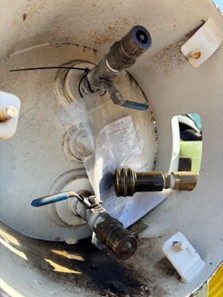
If the inside of the coupling looks dark, crusty, corroded, or tight, the coupling should be cleaned, inspected, and replaced if needed. Parker’s guidance calls for a continuing maintenance program and includes visual inspection for corrosion, leaks, excess dirt buildup on the locking system, and contamination on the coupling interface.
For TELONE™ service, also verify that all wetted components are compatible with the product. Teleos equipment-compatibility guidance emphasizes reviewing TELONE™-wetted components such as valves, transfer hoses, dry-lock adapters, application plumbing, and custom adapters, and replacing questionable components with approved materials.
Download this information in PDF form here.
Disclaimer:
The resources and information provided are meant purely for educational discussion, contains only general information about legal matters, and is not to be construed as advice. Please note that any information or resources provided are not legal or regulatory advice, and should not be treated as such. You must not rely on the information provided as an alternative to legal advice from your attorney or other professional services. Teleos Ag encourages readers to consult with counsel, and their local, county, and state regulators. We make no representations or warranties, express or implied, in relation to the information provided through our resources and blog posts. It is the readers responsibility to know the laws related to 1,3- D, appropriate PPE, Licensing, etc., in his or her City, County, State, and Country.

- BEFORE YOU START THE TRANSFER: A 60-SECOND TELONE TRANSFER CHECK - September 14, 2026
- CYLINDER QUICK-CONNECT FITTING CARE: Proper Use & Care for 110-Gallon Pig Connections - August 12, 2026
- VALVING ON APPLICATION EQUIPMENT - June 15, 2026